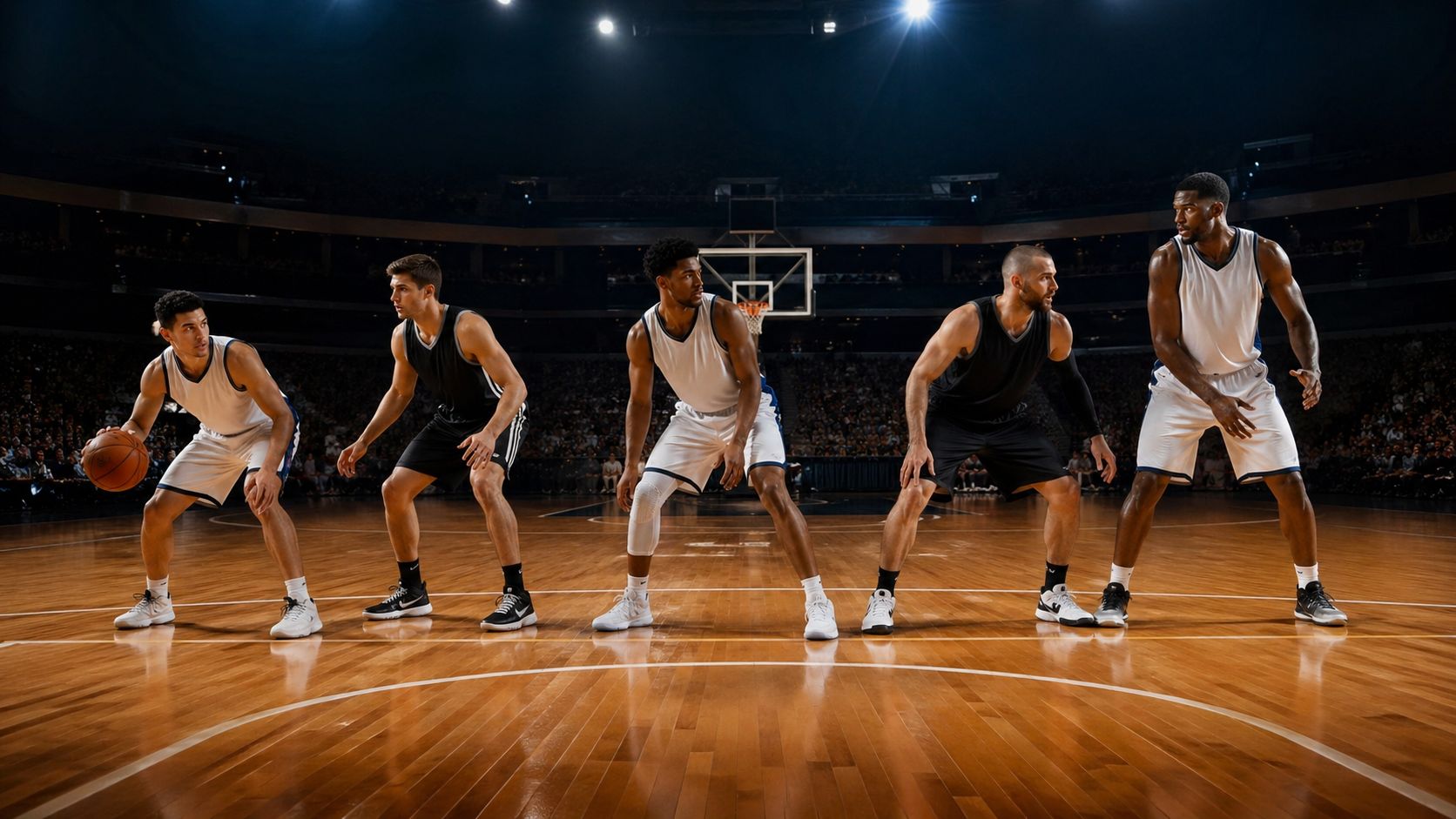
The point guard stands as the heartbeat of every basketball team, the floor general who turns chaos into rhythm and instinct into strategy. Unlike other positions that focus on scoring or defense, the point guard’s role demands an elevated perspective—seeing not just the play unfolding, but what’s about to happen two or three moves ahead. Court vision is the invisible art that defines the greats from the good. It’s the ability to interpret angles, anticipate movements, and understand space in real time. Every successful offense, every fluid transition, every perfectly timed assist starts with the mind of a point guard who can read the game like a grandmaster reads a chessboard. They may not always lead in points, but they lead in presence, in awareness, and in influence. Understanding what drives their decisions reveals the true intelligence behind basketball’s most cerebral position.
A: Scan early, call lifts/shakes, and decide before the dribble—pass on the move.
A: Paint touch → floater/push shot, or pocket to short roll with corner drift.
A: Slip timing with your big, or attack the mismatch into paint-to-spray threes.
A: When the on-ball defender dies and the big overplays angle—recenter to keep options.
A: Jump-stop in paint, throw to space (not bodies), and deliver on time/side.
A: Be loud, precise with calls, praise role execution, and own ATO clarity.
A: Two-ball dribble with numbered calls, skip-read drills, and no-look pocket reps.
A: Shoot/pass/drive within half a second—keep advantage alive.
A: Lead him to space: pocket on roll, lob when weakside tags late, or hit dunker spot.
A: Essential—threat of pull-up forces coverage to commit, opening passes.
The Anatomy of Court Vision
Court vision isn’t something easily taught—it’s a complex fusion of spatial intelligence, peripheral awareness, and instinct. The best point guards seem to possess a sixth sense, a panoramic understanding of the court that allows them to thread passes through defenders who never even saw the play developing. This ability begins with how they process visual information. A point guard’s eyes constantly scan the floor, taking mental snapshots of player positioning, defensive rotations, and time on the shot clock.
They aren’t merely watching the ball—they’re tracking an ecosystem in motion. Court vision also involves rhythm. Like a musician feeling tempo, the point guard senses when to accelerate or slow the pace, dictating flow with each dribble. They anticipate how defenders will react before they even move, and they manipulate space through timing and deception. The result is basketball in its most cerebral form—a dance between instinct and intellect.
Legends of Vision: Masters Who Saw the Game Differently
Throughout basketball history, certain point guards have embodied court vision at a transcendent level. Magic Johnson redefined what it meant to see the floor, using his 6’9” frame to peer over defenses and execute passes that defied physics. His no-look assists became legend, but what truly made Magic extraordinary was his anticipation—he didn’t react, he orchestrated. Then there was John Stockton, whose quiet precision and decision-making made him the NBA’s all-time assists leader. His passes weren’t flashy, but they were surgical, cutting through defenses with mathematical efficiency. Steve Nash brought a new rhythm to the position, using pace and creativity to turn fast breaks into art. His combination of vision and finesse turned the Phoenix Suns’ offense into poetry. And today’s modern maestros, like Chris Paul, Luka Dončić, and Stephen Curry, carry that torch forward, blending intelligence with innovation. Each of these players changed the way we understand point guard play—proving that vision, not just talent, drives greatness.
Thinking in Motion: The Cognitive Science Behind Decision-Making
What happens inside a point guard’s mind during a live play borders on the extraordinary. Neuroscientists studying elite athletes have discovered that their brains process visual and spatial data significantly faster than the average person. For point guards, this translates into predictive thinking—they’re not just observing what is; they’re forecasting what will be.
Every time they dribble across half-court, they’re computing options: who’s cutting, who’s screening, who’s losing their defender by half a step. The best ones can process multiple variables simultaneously, updating mental maps of the court on the fly. This rapid-fire cognition enables split-second decisions that can shift the momentum of a game. But court vision isn’t purely instinctual; it’s also trained.
Years of repetition, film study, and in-game experience sharpen these mental pathways. Over time, the mind of a point guard becomes a living database of tendencies—how defenders react to fakes, how teammates prefer to receive passes, and when to gamble versus play it safe. This is the science of intuition turned into strategy.
The Language of Leadership
To truly understand court vision, one must also understand communication. A point guard’s voice and body language are extensions of their vision. They are translators between the coach’s plan and the players’ execution. Every gesture, glance, and hand signal conveys intent. Court vision, then, is not only about seeing—it’s about directing. The point guard must inspire trust, command attention, and maintain control even in chaos. Great ones lead not through volume but through clarity.
Magic Johnson led with charisma; Jason Kidd with composure; Chris Paul with vocal precision. Leadership from the point guard position means being both selfless and assertive. You must distribute opportunities yet know when to seize them yourself. It’s a delicate balance between confidence and collaboration. When a team has a point guard who can both see and communicate vision, they become an extension of one consciousness—a single, unified purpose on the floor.
Vision Meets Artistry: The Craft of Creativity
Court vision isn’t just about function—it’s also about flair. The best point guards blend logic with imagination, turning simple plays into moments of brilliance. A no-look pass, a perfectly timed alley-oop, or a behind-the-back assist might look spontaneous, but these plays stem from understanding geometry in motion. Creativity amplifies the practical by making it unpredictable. When defenders expect a straightforward play, the great point guards defy those expectations with improvisation. They create art out of opportunity. Magic Johnson had showmanship; Steve Nash had finesse; Kyrie Irving has improvisational genius. Each used creativity not for self-expression alone but as a strategic weapon—disorienting defenses and igniting their teams’ momentum. Creativity in court vision is about bending reality, manipulating angles, and crafting something memorable out of what others might see as ordinary. It’s the difference between simply making a play and making history.
Modern Evolution: The Position Redefined
The role of the point guard has evolved drastically over the decades. Once purely a distributor, today’s point guards are expected to score, defend, and command the floor with multidimensional skill. Players like Stephen Curry and Damian Lillard have redefined the meaning of court vision by expanding their range beyond traditional parameters. Their ability to pull up from deep changes defensive spacing and opens new passing lanes. The modern point guard must master both physical execution and tactical adaptation. They navigate a faster, more three-point-oriented game where transition offense is paramount and every second counts. Yet the essence remains the same—control through clarity.
Whether it’s orchestrating a fast break or setting up a high pick-and-roll, the modern point guard must constantly balance aggression with awareness. They are the bridge between eras: the inheritors of Magic’s imagination and Stockton’s precision, armed with new tools for a new age.
Vision Beyond the Game: Life Lessons from the Point Guard Mentality
What makes the point guard’s mindset so fascinating is how transferable it is beyond basketball. Court vision in life means awareness, empathy, and anticipation. It’s about reading situations, understanding people, and making decisions that elevate everyone around you.
The discipline required to lead on the court translates into leadership off it—patience under pressure, communication during chaos, and adaptability in uncertainty. Many of the greatest point guards, from Isiah Thomas to Sue Bird, have carried their leadership qualities into coaching, business, and advocacy.
Their ability to see the big picture while managing details mirrors success in every field. The point guard’s approach teaches that true vision isn’t about control—it’s about connection. It’s about aligning others toward a shared goal, maintaining composure when everything moves at full speed, and seeing potential where others only see obstacles.
The Eternal Vision: Where Greatness Lives On
Court vision is more than a basketball skill—it’s a philosophy. It represents how intelligence, awareness, and creativity can turn a team into a masterpiece. The greatest point guards in history are remembered not just for their assists or accolades, but for how they made others better. They expanded the definition of teamwork, showing that greatness isn’t measured solely in numbers but in harmony, flow, and impact. The art of court vision will continue to evolve, but its essence will remain timeless: the ability to see the invisible, to think before others react, and to create beauty out of motion. Inside the mind of a point guard lies a world of vision few ever truly understand—a world where instinct meets intellect, where leadership meets artistry, and where every play becomes a reflection of something deeper. To see the court like a point guard is to see possibility itself.