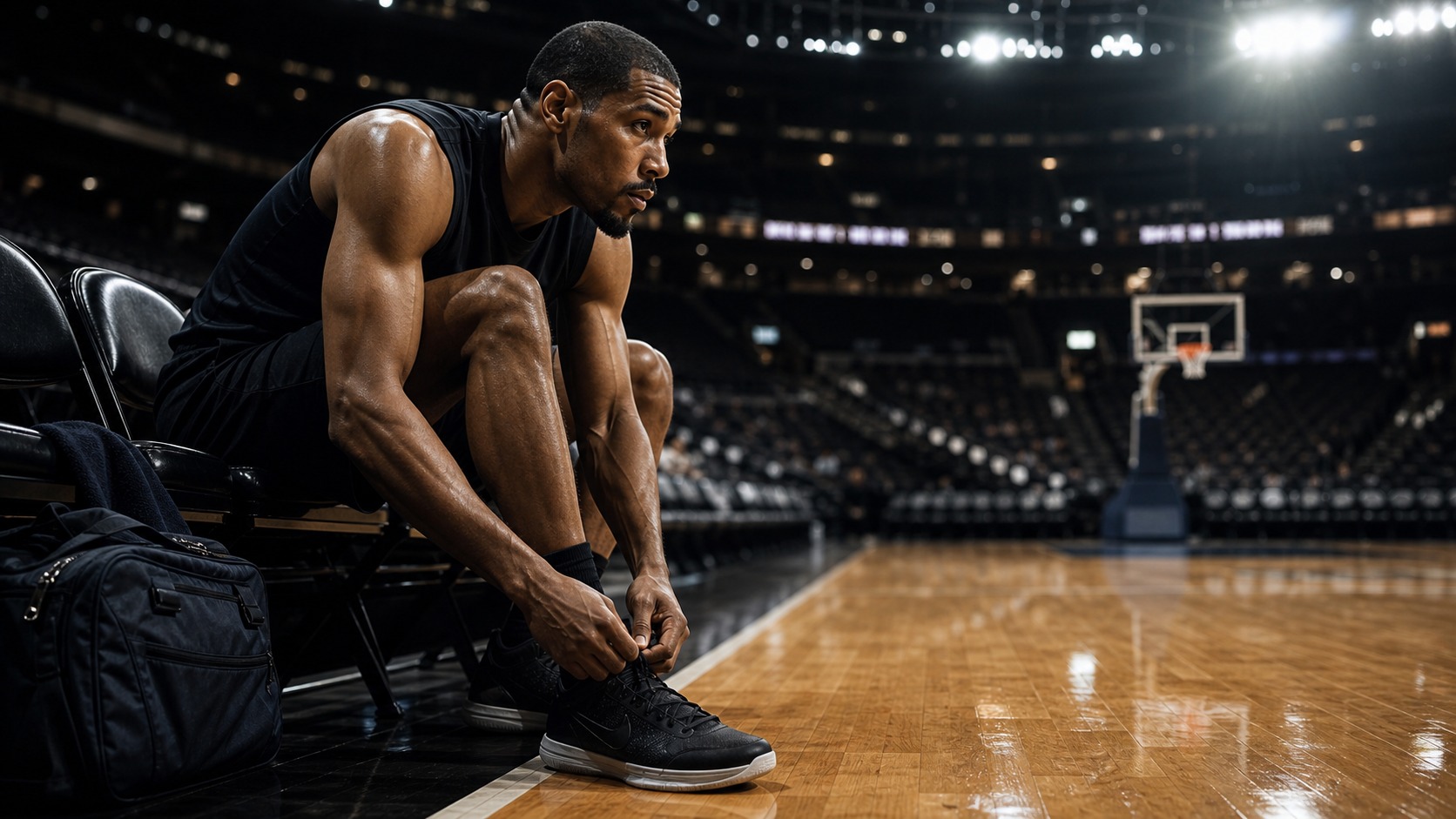
There is something almost hypnotic about the sound of a perfect swish—the clean, satisfying snap of a basketball slicing through the net without touching the rim. It’s a moment that blends science, art, and instinct into one flawless motion. Behind every great shot lies a blend of biomechanics, geometry, and psychology. Whether it’s a Stephen Curry deep three, a Ray Allen corner jumper, or a Dirk Nowitzki fadeaway, every shot follows the same universal principles that govern motion, force, and accuracy. Shooting a basketball is more than an athletic skill—it’s a scientific equation solved in real time, requiring timing, rhythm, and precision. Understanding the science behind that motion reveals just how extraordinary it is that humans can so consistently send a spinning ball through an 18-inch-wide rim from 20 feet away.
A: Add arc via deeper knee load and smoother rise; avoid pushing with the shoulder.
A: Check feet/hip alignment and ensure guide-hand stays passive.
A: A small, consistent dip helps rhythm; keep it compact under pressure.
A: Moderate and repeatable; too much kills distance, too little hardens bounce.
A: Same release—generate power from legs and timing, not extra arm push.
A: Use both—hop for speed, 1-2 for rhythm on angled passes.
A: Finish workouts with pressure sets; maintain form cues despite tired legs.
A: Re-commit to full follow-through and vertical lift.
A: Many shooters prefer center/back rim or a specific hook for depth.
A: Track makes, arc estimates, and miss charts; look for tighter clusters over time.
Anatomy of the Perfect Shooting Motion
Every great shot begins with the foundation—the body’s mechanics working in harmony. From the ground up, the shooter’s kinetic chain transfers energy in a fluid sequence: legs generate power, the core stabilizes balance, and the arms deliver precision.
A perfect shot starts with foot placement—shoulder-width apart, knees slightly bent, and weight evenly distributed. As the shooter rises, energy travels upward in a wave-like motion. The release point, ideally near the apex of the jump, becomes the culmination of that entire energy transfer.
The wrist snaps forward, imparting backspin, which stabilizes flight and softens the ball’s descent. When executed flawlessly, it’s a symphony of muscle coordination and timing. Every millisecond counts. Too early a release flattens the arc; too late, and the shot loses rhythm. The perfect shot isn’t forced—it flows, driven by mechanics refined through thousands of repetitions until they become instinct.
The Magic of Arc: Why Trajectory Matters
One of the most critical yet misunderstood elements of shooting is arc—the angle and height of the ball’s flight. Science has revealed that the optimal shooting angle for a basketball lies between 45 and 52 degrees, depending on distance. This arc maximizes the ball’s entry area into the hoop, increasing the margin for error. Too flat of a shot reduces the entry window, while too high creates inconsistency. The sweet spot lies in the balance between power and precision. Players like Stephen Curry and Klay Thompson have mastered this equilibrium, their shots arching gracefully before descending with mathematical precision.
The beauty of the arc also lies in physics: gravity, velocity, and spin interact to create a consistent parabolic curve. The ball’s backspin not only stabilizes its flight but helps it “soften” upon contact with the rim, increasing the likelihood of a favorable bounce. Every perfect shot you see isn’t luck—it’s physics performing poetry.
Spin, Speed, and Symmetry: The Physics of Ball Flight
When a shooter releases the ball, dozens of physical forces immediately begin to act upon it. The Magnus effect, for example, explains how the ball’s backspin generates lift, keeping it in the air longer and giving it that signature floating appearance.
The average professional shot rotates about two and a half times per second, enough to stabilize its trajectory without overcompensating for drag. The combination of angular velocity and launch speed determines the ball’s ability to hold its line. A ball released too fast will flatten; too slow, and it will fall short. Precision shooting requires this perfect harmony of force and finesse. The symmetry of release also plays a role—shooters aim for a straight follow-through, where the wrist and fingers guide the ball like an arrow. Even minor deviations in angle or spin can send a shot off course by inches, the difference between a perfect swish and a heartbreaking rim-out.
The Mind-Body Connection in Shooting
Beyond muscle memory and physics, the perfect shot is also a mental masterpiece. Confidence and rhythm shape every motion. Neuroscientists studying elite shooters have found that the brain enters a flow state during optimal performance—a balance between focus and relaxation. In this state, external distractions fade away, and the shooter’s awareness narrows to a single focal point: the rim. Visualization plays a major role as well. Players often imagine the trajectory of their shot before releasing the ball, effectively programming their mind to guide their mechanics. Repetition builds consistency, but confidence powers execution. A shooter with sound mechanics but a hesitant mindset will falter, while one with conviction often performs beyond logic. Shooting, then, is as much about psychology as biomechanics. The greatest shooters train their minds to stay calm under pressure, synchronizing thought and motion until precision feels effortless.
From Practice to Perfection: Training the Mechanics
Behind every perfect shot is relentless repetition. Muscle memory isn’t just a phrase—it’s the brain’s way of automating complex movements. Through repetition, neural pathways strengthen, allowing the body to perform with minimal conscious effort. Shooters spend countless hours fine-tuning mechanics, focusing on rhythm, release, and follow-through. Drills like form shooting, free-throw routines, and spot repetitions all serve to engrain mechanical consistency.
But it’s not just about quantity—it’s about quality. Each repetition must reinforce proper movement patterns, ensuring precision under fatigue or pressure. Coaches often emphasize the “BEEF” principle—Balance, Eyes, Elbow, Follow-through—as a framework for developing reliable mechanics. Yet even with this structure, every shooter personalizes their motion slightly. What unites them all is rhythm. When rhythm and mechanics align, the shot becomes an unconscious reflex—a natural extension of the body’s movement, sculpted by years of disciplined practice.
The Influence of Technology and Analytics
Modern basketball has transformed shooting into a science of precision analytics. High-speed motion cameras, biomechanical tracking systems, and advanced data models have given coaches and players insights that were once impossible to quantify.
Systems like Noah and RSPCT measure shooting arc, depth, and left-right accuracy in real time, providing instant feedback to refine form. Data now shows that elite shooters consistently land the ball about 11 inches deep into the hoop’s center—slightly beyond the midpoint, optimizing arc and entry angle. Motion sensors can analyze a shooter’s release consistency down to fractions of a degree. The result is a new era where the art of shooting is continuously optimized through technology.
Players use video analysis to correct minor mechanical flaws, from wrist angles to hip rotation. The blend of analytics and intuition has elevated modern shooting to unprecedented heights—where precision meets performance in perfect harmony.
Legends of the Perfect Shot
Throughout basketball history, a few players have elevated shooting to the level of mythology. Larry Bird’s release was pure efficiency—a blend of confidence and minimal motion that made his shot nearly unguardable. Ray Allen turned repetition into ritual, arriving hours early before games to rehearse every angle and distance until perfection became habit. Stephen Curry took shooting to the future, combining speed, range, and rhythm to redefine what’s possible.
His motion is a model of kinetic synergy: compact, balanced, and consistent. Reggie Miller and Dirk Nowitzki brought their own unique signatures to the craft—Miller’s lightning-quick release and Nowitzki’s one-legged fadeaway both masterpieces of geometry and timing. What connects all these legends isn’t just talent—it’s discipline, adaptability, and respect for the science behind their art. They turned mechanics into muscle memory and pressure into poetry. Their greatness reminds us that perfection is not achieved by chance but by choice, through endless dedication to detail.
The Future of the Perfect Shot
The evolution of shooting continues as new generations of players blend technology, training, and innovation. Young athletes study film, analyze biomechanics, and incorporate tools that simulate game pressure. Coaches emphasize individualized mechanics rather than universal form, understanding that anatomy and rhythm vary from player to player. As analytics grow more advanced, the pursuit of the perfect shot becomes both art and engineering. We may one day reach a point where AI and motion capture can design personalized shooting regimens tailored to each athlete’s unique body mechanics. Yet no matter how advanced technology becomes, the essence will remain human—the feeling of balance, timing, and control as the ball leaves the fingertips. The science behind the perfect shot may continue to evolve, but its magic will always lie in that fleeting moment of symmetry and sound when ball meets net. The perfect shot isn’t just physics—it’s the human pursuit of precision, beauty, and mastery.