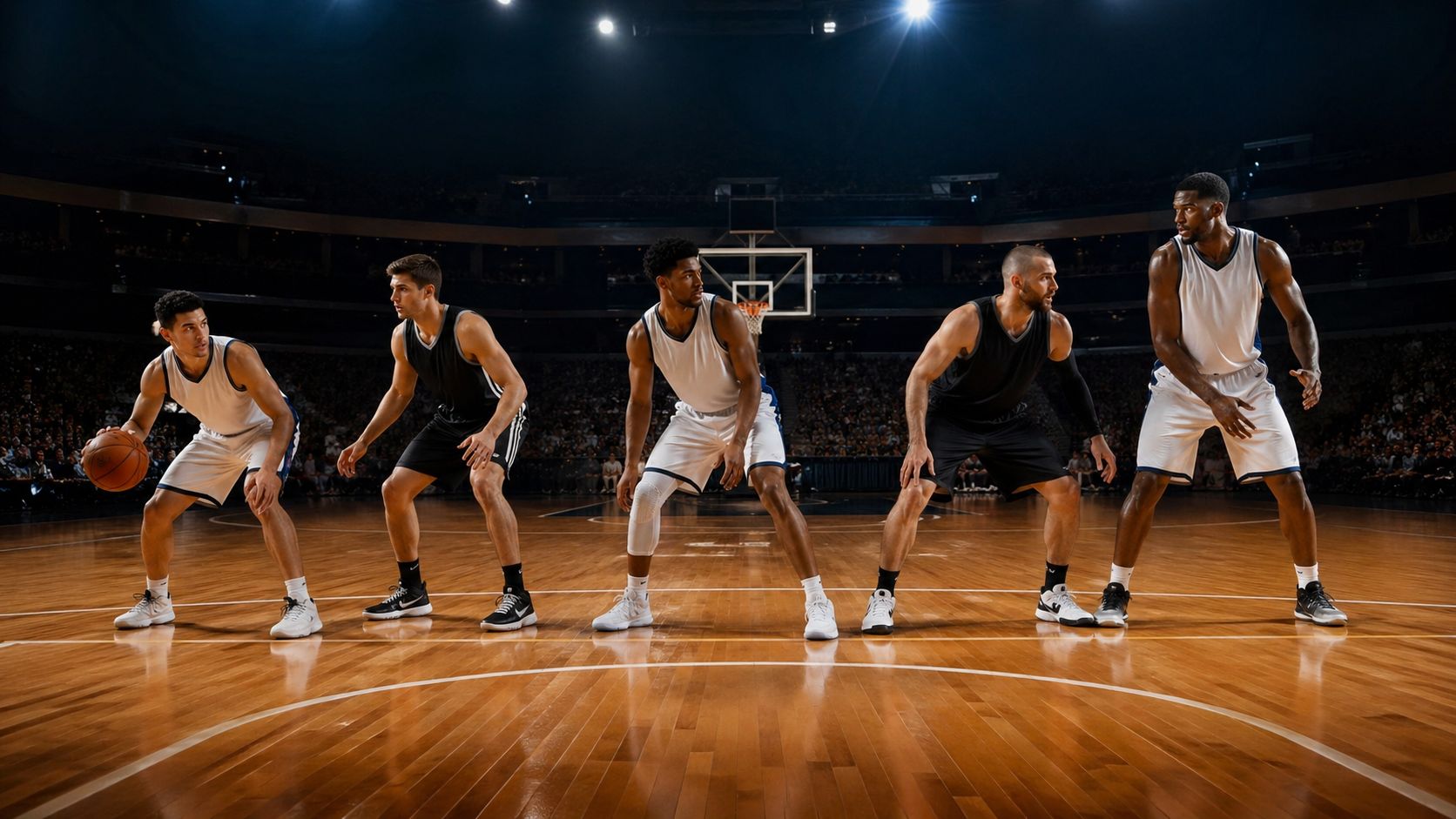
Basketball may look like a fast-moving blur of passes, shots, and defensive stops, but behind the action lies a clear structure that gives the game its rhythm and identity. Every team on the court is built around five core positions, each with its own purpose and responsibility. These roles work together to create balance, allowing teams to score efficiently, defend effectively, and control the flow of the game. Understanding what each position does doesn’t require advanced knowledge or years of experience. At its core, basketball is about spacing, teamwork, and decision-making, and each position contributes to those elements in a unique way. Whether you are new to the game or looking to deepen your understanding, breaking down each role in simple terms reveals just how organized and strategic basketball truly is.
A: A point guard handles the ball, starts the offense, passes, controls tempo, and helps teammates get good shots.
A: A shooting guard scores, shoots from outside, moves without the ball, and defends perimeter players.
A: A small forward plays a versatile role by scoring, defending, rebounding, cutting, and running the floor.
A: A power forward rebounds, screens, defends bigger players, finishes inside, and may shoot from midrange or three.
A: A center protects the rim, rebounds, sets screens, scores near the basket, and controls the paint.
A: The point guard usually handles the ball the most, but skilled wings and bigs may also initiate offense.
A: Shooting guards often take many perimeter shots, but any position can be a high-volume scorer.
A: Centers and power forwards usually rebound the most because they play closest to the basket.
A: Beginners should start by learning passing, defense, spacing, and shooting before worrying too much about labels.
A: Yes, many players play multiple positions depending on their size, skill, speed, and team needs.
The Playmaker’s Command: What the Point Guard Really Does
The point guard is the player who sets everything in motion. Often the smallest but most skilled ball handler on the team, this position is responsible for bringing the ball up the court and starting the offense. Think of the point guard as the director of a play, calling out instructions and making sure every player is in the right place at the right time.
A point guard’s main job is to pass the ball and create scoring opportunities for teammates. This means reading the defense, spotting open players, and delivering accurate passes under pressure. They also decide the tempo of the game, slowing things down when needed or pushing the pace to create fast-break chances.
While scoring is not always their primary focus, many point guards are capable shooters and drivers. Their ability to score keeps defenses honest and opens up more passing lanes. On defense, they usually guard the opposing team’s ball handler, applying pressure and trying to disrupt plays before they develop. Overall, the point guard controls the game from start to finish.
The Bucket Getter: The Real Role of the Shooting Guard
The shooting guard is typically the team’s main scorer, especially from the outside. This position is designed for players who can consistently put the ball in the basket, whether it’s through jump shots, three-pointers, or aggressive drives to the rim. While the point guard creates opportunities, the shooting guard often finishes them.
A key part of this role is movement without the ball. Shooting guards are constantly running through screens, finding open spaces, and positioning themselves to receive passes in scoring positions. Their ability to catch and shoot quickly makes them dangerous at all times.
In addition to scoring, shooting guards must also be capable defenders. They often match up against the opponent’s best perimeter scorer, requiring strong footwork and awareness. In today’s game, many shooting guards also handle the ball more than in the past, sharing playmaking duties and adding another layer to the offense. Still, their primary identity remains tied to scoring and offensive production.
The All-Around Threat: Breaking Down the Small Forward
The small forward is often considered the most complete player on the court. This position blends the skills of guards and forwards, making it one of the most versatile roles in basketball. A small forward can score, defend, rebound, and pass, adapting to whatever the team needs in a given moment.
Offensively, small forwards can attack in multiple ways. They can shoot from the perimeter, drive past defenders, or post up smaller players. This versatility makes them difficult to guard, as they don’t rely on just one skill to succeed. They are often used as matchup problems, forcing the defense to adjust.
Defensively, small forwards are usually tasked with guarding a variety of players. They must be strong enough to handle bigger opponents while also being quick enough to stay in front of guards. Their ability to switch between different defensive assignments is crucial in modern basketball.
Because they contribute in so many areas, small forwards often act as the glue that holds the team together. They fill in gaps, support teammates, and keep the game flowing smoothly on both ends of the court.
The Muscle in the Middle: Understanding the Power Forward
The power forward brings strength and physicality to the game. This position operates mainly near the basket, focusing on rebounding, defending, and scoring in close range. Power forwards are often involved in the toughest parts of the game, battling for position and fighting for loose balls.
Offensively, power forwards score through post moves, short jump shots, and second-chance opportunities. They are frequently positioned near the rim, ready to grab rebounds and convert them into points. In modern basketball, many power forwards have expanded their skill set to include outside shooting, adding spacing to the offense.
Defensively, the power forward plays a major role in protecting the paint. They help block shots, contest drives, and secure rebounds. Their presence makes it more difficult for opponents to score inside. This position requires both strength and mobility, as power forwards must handle physical matchups while also being able to move quickly when needed.
The power forward may not always get the spotlight, but their contributions are essential to a team’s success, especially when it comes to controlling the physical side of the game.
The Anchor of the Paint: What the Center Is Responsible For
The center is typically the tallest player on the team and serves as the foundation of the defense. Positioned near the basket, this player is responsible for protecting the rim, grabbing rebounds, and scoring close to the hoop. The center’s presence in the paint can completely change how a game is played.
On offense, centers focus on high-percentage shots near the basket. They use their size and strength to finish plays, often scoring through dunks, layups, and post moves. Setting screens is another important responsibility, helping teammates get open for shots or drives.
Defensively, the center is the last line of defense. They block shots, alter attempts, and make opponents think twice about attacking the basket. Rebounding is also a key part of their role, as controlling missed shots can determine who gains possession.
In recent years, the center position has evolved, with some players developing shooting and ball-handling skills. However, their core responsibilities remain rooted in protecting the paint and dominating the area near the basket.
How It All Fits Together: Teamwork Across All Five Positions
While each position has its own responsibilities, basketball is ultimately a team game where every role must connect seamlessly. The point guard initiates plays, the shooting guard finishes scoring opportunities, the small forward adapts to fill gaps, the power forward controls the physical battles, and the center anchors the defense.
When these roles are executed correctly, the result is a balanced and efficient team. Spacing becomes smoother, passing becomes sharper, and defensive rotations become more effective. Each player depends on the others, creating a system where teamwork and communication are essential.
A successful team doesn’t just rely on individual talent but on how well each position complements the others. Understanding this connection is key to appreciating the strategy behind the game and recognizing why certain lineups and systems work better than others.
The Modern Twist: Why Positions Are More Flexible Than Ever
Basketball has changed dramatically over time, and one of the biggest shifts has been the way positions are used. While the traditional five-position system still exists, today’s game often emphasizes versatility and skill over strict roles. Players are no longer confined to a single position, and many are expected to do a little bit of everything.
This evolution has led to what is often called positionless basketball. In this style of play, a center might shoot three-pointers, a forward might handle the ball, and a guard might play in the post. Teams prioritize flexibility, allowing players to adapt based on matchups and game situations.
This shift has made the game faster and more dynamic, with more spacing and movement than ever before. It also means that understanding the basics of each position is more important than ever, as players must be ready to take on multiple responsibilities.
Finding Your Role: Learning the Game Through Position Understanding
For anyone learning basketball, understanding positions is one of the best ways to improve. Knowing what each role does helps players make better decisions, communicate more effectively, and contribute to the team in meaningful ways. It also allows players to discover where they fit best based on their skills and strengths. Some players naturally gravitate toward handling the ball and controlling the game, making them ideal for the point guard position. Others excel at scoring, finding their place as shooting guards. Versatile athletes often thrive as small forwards, while those with strength and size may take on power forward or center roles. At the same time, modern basketball encourages players to develop a wide range of skills, regardless of position. Learning to shoot, pass, defend, and rebound creates more opportunities and makes a player more valuable on the court. In the end, basketball positions are not just labels but tools for understanding the game. They provide a simple framework that helps players and fans make sense of the action, revealing the strategy and teamwork that make basketball one of the most exciting sports in the world.